Wednesday, 20 July 2011

Molecular gastronomy

Molecular gastronomy is a discipline practiced by both scientists and food professionals that studies the physical and chemical processes that occur while cooking. It is also the use of such studied processes in many professional kitchens and labs.[3] Molecular gastronomy seeks to investigate and explain the chemical reasons behind the transformation of ingredients, as well as the social, artistic and technical components of culinary and gastronomic phenomena in general.
"Molecular gastronomy" also refers to a modern style of cooking, which takes advantage of innovations from the scientific discipline.

As a science

 Founding

There are many branches of food science, all of which study different aspects of food such as safety, microbiology, preservation, chemistry, engineering, physics and the like. Until the advent of molecular gastronomy, there was no formal scientific discipline dedicated to studying the processes in regular cooking as done in the home or in a restaurant. The aforementioned have mostly been concerned with industrial food production and while the disciplines may overlap with each other to varying degrees, they are considered separate areas of investigation.
Though many disparate examples of the scientific investigation of cooking exist throughout history, the creation of the discipline of molecular gastronomy was intended to bring together what had previously been fragmented and isolated investigation into the chemical and physical processes of cooking into an organized discipline within food science to address what the other disciplines within food science either do not cover, or cover in a manner intended for scientists rather than cooks. These mere investigations into the scientific process of cooking have unintentionally evolved into a revolutionary epicurean practice that is now prominent in today's culinary world.

 Origin of term

The term "Molecular and Physical Gastronomy" was coined in 1992 by Hungarian physicist Nicholas Kurti and French physical chemist Hervé This. It became the title for a set of workshops held in Erice, Italy (originally titled "Science and Gastronomy")[4] that brought together scientists and professional cooks for discussions on the science behind traditional cooking preparations. Eventually, the shortened term "Molecular Gastronomy" also became the name of the scientific discipline co-created by Kurti and This to be based on exploring the science behind traditional cooking methods.[4][5][6]
Kurti and This had been the co-directors of the "Molecular and Physical Gastronomy" meetings in Erice, along with the American food science writer Harold McGee,[4] and had considered the creation of a formal discipline around the subjects discussed in the meetings.[6] After Kurti's death in 1998, the name of the Erice workshops was also changed by This to "The International Workshop on Molecular Gastronomy 'N. Kurti'". This remained the sole director of the subsequent workshops from 1999 through 2004 and continues his research in the field of Molecular Gastronomy today.

 Fundamental objectives according to Hervé This

The objectives of molecular gastronomy, as defined by Hervé This are:
Current objectives:
Looking for the mechanisms of culinary transformations and processes (from a chemical and physical point of view) in three areas:[5][7]
  1. the social phenomena linked to culinary activity
  2. the artistic component of culinary activity
  3. the technical component of culinary activity
Original objectives:
The original fundamental objectives of molecular gastronomy were defined by This in his doctoral dissertation as:[7]
  1. Investigating culinary and gastronomical proverbs, sayings, and old wives' tales
  2. Exploring existing recipes
  3. Introducing new tools, ingredients and methods into the kitchen
  4. Inventing new dishes
  5. Using molecular gastronomy to help the general public understand the contribution of science to society
However, This later recognized points 3, 4 and 5 as being not entirely scientific endeavours (more application of technology and educational), and has since revised the primary objectives of molecular gastronomy.[3]

[edit] Examples of molecular gastronomy

Example areas of investigation:[8]
  • How ingredients are changed by different cooking methods
  • How all the senses play their own roles in our appreciation of food
  • The mechanisms of aroma release and the perception of taste and flavor
  • How and why we evolved our particular taste and flavor sense organs and our general food likes and dislikes
  • How cooking methods affect the eventual flavor and texture of food ingredients
  • How new cooking methods might produce improved results of texture and flavor
  • How our brains interpret the signals from all our senses to tell us the "flavor" of food
  • How our enjoyment of food is affected by other influences, our environment, our mood, how it is presented, who prepares it, etc.
Example myths debunked:[9][10]
  • You need to add salt to water when cooking green vegetables
  • Searing meat seals in the juices
  • The cooking time for roast meat depends on the weight
  • When cooking meat stock you must start with cold water.

[edit] International meetings in Erice, Italy

Though she is rarely credited, the origins of the Erice workshops (originally entitled "Science and Gastronomy") can be traced back to the cooking teacher Elizabeth Cawdry Thomas who studied at Le Cordon Bleu in London and ran a cooking school in Berkeley, CA. The one time wife of a physicist, Thomas had many friends in the scientific community and an interest in the science of cooking. In 1988 while attending a meeting at the Ettore Majorana Center for Scientific Culture in Erice, Thomas had a conversation with Professor Ugo Valdrè of the University of Bologna who agreed with her that the science of cooking was an undervalued subject and encouraged her to organize a workshop at the Ettore Majorana Center. Thomas eventually approached the director of the Ettore Majorana center, physicist Antonino Zichichi who liked the idea. Thomas and Valdrè approached Kurti to be the director of the workshop. By Kurti's invitation, noted food science writer Harold McGee and French Physical Chemist Hervé This became the co-organizers of the workshops, though McGee stepped down after the first meeting in 1992.[4]
Up until 2001, The International Workshop on Molecular Gastronomy "N. Kurti" (IWMG) was named the "International Workshops of Molecular and Physical Gastronomy" (IWMPG). The first meeting was held in 1992 and the meetings have continued every few years there after until the most recent in 2004. Each meeting encompassed an overall theme broken down into multiple sessions over the course of a few days.[11]
The focus of the workshops each year were as follows:[12][13]
  • 1992 - First Meeting
  • 1995 - Sauces, or dishes made from them
  • 1997 - Heat in cooking
  • 1999 - Food flavors - how to get them, how to distribute them, how to keep them
  • 2001 - Textures of Food: How to create them?
  • 2004 - Interactions of food and liquids
Examples of sessions within these meetings have included:[13][14]
  • Chemical Reactions in Cooking
  • Heat Conduction, Convection and Transfer
  • Physical aspects of food/liquid interaction
  • When liquid meets food at low temperature
  • Solubility problems, dispersion, texture/flavour relationship
  • Stability of flavour
Heated bath used for low temperature cooking
Rotary evaporator used in the preparation of distillates and extracts

 Nicholas Kurti and Hervé This

The Hungarian born physicist Nicholas Kurti (1908–1998) became Professor of Physics at Oxford in 1967, a post he held until his retirement in 1975. He was also visiting Professor at The City College of New York, the University of California, Berkeley, and Amherst College in Massachusetts. His hobby was cooking, and he was an enthusiastic advocate of applying scientific knowledge to culinary problems. He was one of the first television cooks in the UK, hosting a black and white television show in 1969 entitled "The Physicist in the Kitchen" where he demonstrated techniques such as using a syringe to inject hot mince pies with brandy in order to avoid disturbing the crust.[15] That same year, he held a presentation for the Royal Society of London (also entitled "The Physicist in the Kitchen") in which he is often quoted to have stated:[16]
I think it is a sad reflection on our civilization that while we can and do measure the temperature in the atmosphere of Venus we do not know what goes on inside our soufflés
—Nicholas Kurti
During the presentation Kurti demonstrated making meringue in a vacuum chamber, the cooking of sausages by connecting them across a car battery, the digestion of protein by fresh pineapple juice, and a reverse baked alaska - hot inside, cold outside - cooked in a microwave oven.[13][16] Kurti was also an advocate of low temperature cooking, repeating 18th century experiments by the English scientist Benjamin Thompson by leaving a 2 kg lamb joint in an oven at 80 °C (176 °F). After 8.5 hours, both the inside and outside temperature of the lamb joint were around 75 °C (167 °F), and the meat was tender and juicy.[16] Together with his wife, Giana Kurti, Nicholas Kurti edited an anthology on food and science by fellows and foreign members of the Royal Society.
Hervé This started collecting "culinary precisions" (old kitchen wives' tales and cooking tricks) in the early 1980s and started testing these precisions to see which ones held up; his collection now numbers some 25,000. He also has received a PhD in Physical Chemistry of Materials for which he wrote his thesis on molecular and physical gastronomy, served as an adviser to the French minister of education, lectured internationally, and was invited to join the lab of Nobel Prize winning molecular chemist Jean-Marie Lehn.[9][17] This has published several books in French, four of which have been translated into English, including Molecular Gastronomy: Exploring the Science of Flavor, Kitchen Mysteries: Revealing the Science of Cooking, Cooking: The Quintessential Art, and Building a Meal: From Molecular Gastronomy to Culinary Constructivism. He currently publishes a series of essays in French and hosts free monthly seminars on molecular gastronomy at the INRA in France. He gives free and public seminars on molecular gastronomy any month, and once a year, he gives a public and free course on molecular gastronomy. Hervé also authors a website and a pair of blogs on the subject in French and publishes monthly collaborations with French chef Pierre Gagnaire on Gagnaire's website.[18][19][20]

[edit] Precursors to molecular gastronomy

Sir Benjamin Thompson, Count Rumford (1753–1814) was one of the early pioneers in the science of food & cooking.
The idea of using techniques developed in chemistry to study food is not a new one, for instance the discipline of food science has existed for many years. Kurti and This acknowledged this fact and though they decided that a new, organized and specific discipline should be created within food science that investigated the processes in regular cooking (as food science was primarily concerned with the nutritional properties of food and developing methods to process food on an industrial scale), there are several notable examples throughout history of investigations into the science of everyday cooking recorded as far as back to 18th century.[3][21]
Professors Evelyn G. Halliday and Isabel T. Noble: In 1943 the University of Chicago Press published a book entitled Food Chemistry and Cookery by the then University of Chicago Associate Professor of Home Economics Evelyn G. Halliday and University of Minnesota Associate Professor of Home Economics Isabel T Noble. In the foreword of the 346 page book the authors state that, “The main purpose of this book is to give an understanding of the chemical principles upon which good practices in food preparation and preservation are based.” [22]
The book includes chapters such as "The Chemistry of Milk", "The Chemistry of Baking Powders and Their Use in Baking", "The Chemistry of Vegetable Cookery" and "Determination of Hydrogen Ion Concentration" and contains numerous illustrations of lab experiments including such things as a Distillation Apparatus for Vegetable Samples and a Pipette for Determining the Relative Viscosity of Pectin Solutions.[22] The professors had previously published The Hows and Whys of Cooking in 1928.[23]
Professor Belle Lowe of Iowa State College (1886–1961): In 1932 a woman named Belle Lowe, then the professor of Food and Nutrition at Iowa State College, published a book entitled Experimental Cookery: From The Chemical And Physical Standpoint which became a standard textbook for home economics courses across the United States. The book is an exhaustively researched look into the science of everyday cooking referencing hundreds of sources and including many experiments. At a length of over 600 pages with section titles such as “The Relation Of Cookery To Colloidal Chemistry”, “Coagulation Of Proteins”, “The Factors Affecting The Viscosity Of Cream And Ice Cream”, “Syneresis”, “Hydrolysis Of Collagen” and “Changes In Cooked Meat And The Cooking Of Meat”, the volume rivals or exceeds the scope of many other books on the subject, at a much earlier date.[24][25]
Belle Lowe was born near Utica, Missouri on February 7, 1886. She graduated from Chillicothe High School and then received a teaching certificate (1907) from the Kirksville State Normal School in Kirksville, Missouri. She also received a Ph. B. (1911) and an M.S. (1934) from the University of Chicago. In 1957, Lowe received an honorary Ph.D. from Iowa State College (University). In addition to “Experimental Cookery”, she published numerous articles on the subject of the science of cooking. She died in 1961.[26]
According to Hervé This:
In the second century BC, the anonymous author of a papyrus kept in London used a balance to determine whether fermented meat was lighter than fresh meat. Since then, many scientists have been interested in food and cooking. In particular, the preparation of meat stock—the aqueous solution obtained by thermal processing of animal tissues in water—has been of great interest. It was first mentioned in the fourth century BC by Apicius (André (ed), 1987), and recipes for stock preparation appear in classic texts (La Varenne, 1651; Menon, 1756; Carême & Plumerey, 1981) and most French culinary books. Chemists have been interested in meat stock preparation and, more generally, food preparation since the eighteenth century (Lémery, 1705; Geoffrey le Cadet, 1733; Cadet de Vaux, 1818; Darcet, 1830). Antoine-Laurent de Lavoisier is perhaps the most famous among them—in 1783, he studied the processes of stock preparation by measuring density to evaluate quality (Lavoisier, 1783). In reporting the results of his experiments, Lavoisier wrote, "Whenever one considers the most familiar objects, the simplest things, it's impossible not to be surprised to see how our ideas are vague and uncertain, and how, as a consequence, it is important to fix them by experiments and facts" (author's translation). Of course, Justus von Liebig should not be forgotten in the history of culinary science (von Liebig, 1852) and stock was not his only concern. Another important figure was Benjamin Thompson, later knighted Count Rumford, who studied culinary transformations and made many proposals and inventions to improve them, for example by inventing a special coffee pot for better brewing. There are too many scientists who have contributed to the science of food preparation to list here. — Hervé This, 2006[3][27]
Marie-Antoine Carême (1784–1833): The concept of molecular gastronomy was perhaps presaged by Marie-Antoine Carême, one of the most famous French chefs, who said in the early 19th century that when making a food stock "the broth must come to a boil very slowly, otherwise the albumin coagulates, hardens; the water, not having time to penetrate the meat, prevents the gelatinous part of the osmazome from detaching itself."

 As a style of cooking

The term molecular gastronomy was originally intended to refer only to the scientific investigation of cooking,[28] though it has been adopted by a number of people and applied to cooking itself or to describe a style of cuisine.
In the late 1990s and early 2000s, the term started to be used to describe a new style of cooking in which some chefs began to explore new possibilities in the kitchen by embracing science, research, technological advances in equipment and various natural gums and hydrocolloids produced by the commercial food processing industry.[29][30][31][32] It has since been used to describe the food and cooking of a number of famous chefs, though many of them do not accept the term as a description of their style of cooking.[33] Other names for the style of cuisine practiced by these chefs have included "New Cuisine", "Progressive Cuisine", "Nueva Cocina", "Culinary Constructivism", "Modern Cuisine", "Avant-Garde Cuisine", "Experimental Cuisine", “Techno-Emotional Cuisine”, “Molecular Cuisine” and “Molecular Cooking”, though no singular name has ever been applied in consensus and the term molecular gastronomy continues to be used, in many cases, as a blanket term to refer to any and all of these things - particularly in the media.[34] Ferran Adrià prefers the term 'deconstructivist,' at least in regards to his own style of cooking.[35]

 Chefs

Chefs who are often associated with[by whom?] molecular gastronomy because of their embrace of science include Grant Achatz, Ferran Adrià, José Andrés, Sat Bains, Richard Blais, Marcel Vigneron, Heston Blumenthal, Sean Brock, Homaro Cantu, Michael Carlson, Wylie Dufresne, Pierre Gagnaire, Will Goldfarb, Adam Melonas, Randy Rucker, Kevin Sousa, Sean Wilkinson, Will LaRue and Laurent Gras.[citation needed]


Frustrated[36] with the common mis-classification of their food and cooking as "molecular gastronomy", several chefs often associated with the movement have since repudiated the term, releasing a joint statement in 2006 clarifying their approach to cooking.[33] Still, other modern chefs[who?] have embraced molecular gastronomy. In February 2011, Nathan Myhrvold published the Modernist Cuisine, which led many chefs to further classify molecular gastronomy, versus modernist cuisine. Myhrvold believes that his cooking style should not be called molecular gastonomy.[37]

 Techniques, tools, and ingredients

Our Local Food

Are we fimiliar with our own Malaysian food

"Malaysian food is the best in Asia, it has the most variety and the best quality, explore the Malay, Chinese or Indian cuisine"

Malay Food

The staple food of the Malays is rice, boiled to a white fluffy texture. It is served with dishes of meat (chicken or beef), fish and vegetables. Meat and fish are usually prepared as sambal (chili paste) or curry dish. In fact, Most of the Malaysian food can not be eaten without some spices.

As most Malays (not all Malaysians are Malay!) are Muslim, pork or any food that comes from a pig is never used in Malay cuisine. Even cutlery and crockery used to serve Muslims must not have been used to serve pork.
They are also prohibited from consuming the flesh of predatory animals and predatory birds (ducks are allowed), rodents, reptiles, worms, amphibians (frogs) and the flesh of dead animals. Muslims can only eat meat that is halal. Halal is a way of slaughtering according to the Islamic rites.
Malaysian food (read Malay food) derives its flavor from the use of spices and local ingredients. Some of those ingredients used by the Malays in the Malay cuisine are:
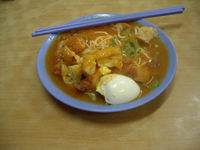
mee rebus
Mee rebus, typical Malaysian food
  • Serai (lemon grass)
  • Bawang merah (shallots
  • Halia (ginger
  • Lengkuas (galangal)
  • Ketumbar (coriander
  • Asam jawa (tamarind)
  • Kunyit (turmeric)
  • Saffron
  • Jintan putih (cumin)
Another ingredient commonly found in Malaysian food is santan which is coconut milk. The milk is squeezed from the flesh of the grated coconut. As a sign of modern times, santan can be found in powder form, sold in supermarkets. It's much used by actually in the Malay cuisine.
The traditional Malay way of eating is by using the right hand. The use of the left hand is considered bad manners. The same goes with receiving or giving things, always use the right hand.
In eating stalls or at homes where hands are used to eat, guests will provided with a pot of water to wash their hands before and after the meal. Remember, this water is not for drinking. Or you simply use the always available tap to wash your hands.
As with other cuisines, Malay food is prepared and enjoyed by all races. A staple breakfast favorite is nasi lemak. It is a simple but very satisfying meal. The rice is cooked in coconut milk with fragrant pandan leaves. Side dishes can be sambal ikan bilis (anchovies with chili), omelets or hard boiled eggs, peanuts, sliced cucumber, prawns and fried fish. If one Malaysia food can be named as the countries national dish, it's probably nasi lemak.
Another classic example of ever popular Malay food is satay. There's no pasar malam (night market) without satay. It usually consists of chunks of chicken marinated with a variety of spices.
barbequed stingray
Barbecued stingray
Ikan bakar is grilled or barbecue fish which you will be able to find almost everywhere. A popular local fish is the Ikan Kembong, Chubb Mackerel, also called Indian Mackerel. This fish is usually marinated in various spices and coconut milk. Apart of mackerel other fish is grilled too. You can eat Spanish Mackerel (ikan tenggiri), Wolf Herring (ikan parang), stingray or Skate Wings (ikan Pari). It's great with some chillies and lime.
Rendang Tok is a meat dish (chicken or beef) prepared with coconut milk, chilies, onion, and other ingredients. Around Pangkor and Lumut the most famous kind of rendang is rendang tok. It contains beef, coconut milk, onion, garlic, chilies, coriander powder, cumin, black pepper, fennel, turmeric root, lemon grass and other ingredients. If you visit a Malay wedding, like I did some time back, you most likely will have some rendang as it is usually used for special occasions.

Laksa

Laksa is a good example of a crossover type of dish. The Malays probably make some of the very best laksa in Malaysia. Laksa is a kind of spicy noodle soup based on fish and spices. Here's a complete page about laksa. When I did my research I was surprised to find out how many different kinds of laksa there were.
Back to the top

Indian food

Malaysian food from the Indian population is quite different from the Malay or Chinese cuisine. The Indians flavor hot and spicy flavors. Their staple diet usually consists of either rice or bread (chapatti, tosai (thosai, dosa in India), parrata, puri). They eat this with various curries. As in accordance with their Hindu beliefs, they do not eat beef.
Teh Tarik, milk tea
Milk Tea, Teh Tarik
The Malaysian food of the Indian population in the North-West part of Malaysia, including Pangkor, can be categorized as Southern-Indian, Northern Indian and Indian Muslim (mamak). Along with the rest of the local cuisine, it has evolved and assimilated according to society's preferences. Sometimes what is considered Indian food here, did not even originated from India.
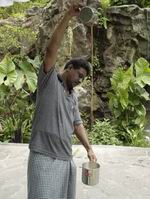
Usually Indian Malaysian food is sold at the various local stalls and often ordered with a glass of teh tarik. Teh Tarik literally means "pulled tea". The tea is thick and frothy. The preparation involves passing the tea and milk from one big metal mug to the other with a "pour and pull" action.
Where there is roti canai, there is bound to be murtabak. This is basically roti canai with stuffing of sardines or chicken as the Indian Hindus do not eat beef. Murtabak with beef however can be obtained from stalls owned by Muslims.
Roti canai
Typical Malaysian food: Roti Canai
Nobody really knows how roti cana came about and would become some of the most popular of all Malaysian food. However, Penang can certainly lay claim to Indian mee (mee goreng or kelinga mee). From Penang, these dishes spread out further over Malaysia and can be eaten in and around Pangkor. The best roti canai in the area however, is not to be found in Pangkor but in Kampong Sitiawan at the riverside.
One could say the apart of nasi lemak, roti canai is probably the second national Malaysian food.
Indian mee was first created by Indian sailors and port workers. It is a combination of Chinese fried noodles with prawn fritters, potato, squid, taukua (bean curd, bean sprouts and lettuce). For more filling, an egg is usually scrambled into the mix. Mention North Indian food and what comes to mind is tandoori chicken and naan bread. Both are cooked in clay oven called tandoori. Northern Indian food is found in air-conditioned restaurants, richly decorated to reflect the Indian culture and Hindu tradition.
Ingredients as yoghurt's and ghee are liberally compared to Southern Indian cuisine, which uses a lot of coconut milk and chilies. Even the staple diet is different, rice for the South, bread for the North. Nevertheless, both are equally spicy and delicious.
Back to the top

Chinese Food

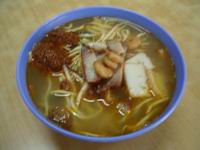
shrimp noodles or hokkien mee
Shrimp noodles or hokkien mee
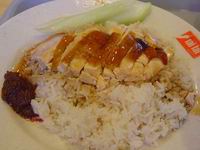
Since most of Malaysia's Chinese are from the south, particularly from Hainan and Hakka it is quite easy to find food from this region. Throughout Malaysia one of the most widespread economical meal is the Hainanese Chicken Rice which cost around the figure of RM 3.00.
It's another of the local favorite Malaysian foods. The Hainanese also produced steamboat, sort of Oriental variation of the Swiss Fondue, where you have a boiling stockpot in the middle of the table into which you deep pieces of meat, seafood and vegetable.
The Hokkiens have provided us the Hokkien fried Mee (thick egg noodles cook with meat, seafood and vegetable and a rich soy sauce. Mind you, if you go to North Malaysia, Hokkien Mee means prawn soup noodles. Hokkien spring rolls (popiah) are also delicious.
chicken rice
Chicken rice
Teochew food from the area around Swatow in China is another style noted for it's delicacy and natural favorite. Teochew food is famous for it's seafood and another economical dish - Char Kwey Teow (fried flattened noodles) with clams, beansprout and prawns.
Hakka dish is also easily found in food centers. The best know hakka dish is the Yong Tau Foo (stuffed seafood bean curd) with soup or thick dark gravy.
When people in the west speak of Chinese food, they probably mean Cantonese food. It is the best known and most popular variety of Chinese food. Cantonese food is noted for the variety and the freshness of it's ingredients. The food are usually stir-fried with just a touch of oil. The result is crisp and fresh. All those best known 'western Chinese' dishes fit into this category - sweet and sour dishes, won ton, chow mein, spring rolls.
With Cantonese food the more people you can muster for the meal the better, because dishes are traditionally shared so everyone will manage to sample the greatest variety. A corollary of this is that Cantonese food should be balance: traditionally, all foods are said to be either Yin (cooling) - like vegetables, most fruits and clear soup; or Yang (healthy) - like starchy foods and meat. A cooling food should be balance with a healthy food and too much of one it would not be good for you.

Dim Sum

Off all Malaysian foods the Cantonese specialty is Dim Sum or 'little heart'. Dim sum is usually consumed during lunch or as a Sunday brunch. Dim sum restaurant are usually large, noisy affair and the dim sum, little snacks that come in small bowls, are whisked around the tables on individual trolleys or carts. As they come by, you simply ask for a plate of this or a bowl of that. At the end the meal you are billed is the amount of empty containers on your table. Read more about Dim Sum
Cantonese cuisine of the Malaysian foods can also offer real extremes. You can get shark's fin soup or bird's nest soup which are expensive delicacies. Cheap dishes include mee (noodles) and congee (rice porridge) and are equally tasty.
Far less familiar than the food from Canton are the cuisines from the north and the west of China - Sichuan, Shanghai and Peking. Sichuan food is usually spicy (gong bao for example is a chicken rice dish with cashew nuts and spices). Where as to food from Canton are delicate and understated, in Sichuan food the flavors are strong. Garlic and chilies play their part in dishes like diced chicken and hot and sour soup.
3 in 1 noodle soup
The huge bowl of the 3 in 1 soup, a mix of laksa, curry mee and ho kien mee
Beijing (Peking) food is, of course best known for the famous 'Peking Duck'. Beijing food are less subtle than Cantonese food. Beijing food is usually eaten with hot steamed bun or with noodles, because rice is not grown in cold region of the north. But in Malaysia, it is more likely to come with rice.
Other kinds of Chinese foods originated from for example Shanghai or Hunan (usually very spicy too) are not easily found over Malaysia.

Mooncake

A very special pastry can be found all over Malaysia during the Moonfestival periode, usually around early October. Here's more about the Moonfestival and Mooncakes.

Restaurants

Although there are a few good Chinese restaurants at Pulau Pangkor (think of the Ye Lin, next to the Coral Bay Resort) or and the Sea View Hotel (try there the re excellent curry mee, some of the best Chinese food is to be found 9 km land inwards in Sitiawan. For some excellent vegetarian food, try Jie Shan Lou Vegetarian Restaurant on the main road in Sitiawan at Jalan Lumut.

Tzien Fatt is to me the best noodle stall in Sitiawan. My favorite dish with Sunny and Doreen is their 3 in 1 soup, a mix of laksa, curry mee and ho kien mee (prawn mee or mee udang). Many locals do not believe this combination could possibly work but agree with me when they finish their bowl. And once you're there, try their special fruit juice. I never ask Sunny what he has, I let him make me a class and I am never disappointed! Fruit juice with ice, contrary to many other places where you get ice with some fruit juice. You get the point.

to be continue

Are you good enough to take the challange -Cooking for the President

Recipe for Success: Cooking for the President


It's not a cabinet position. It doesn't require Senate confirmation. But much like President-elect Obama's inner circle, the person selected as the next White House chef will face a daunting task: Ensuring the security and well-being of the commander in chief's stomach.
In an age of celebrity chefs, the president-elect's pick for White House chef -- not yet announced -- is now more closely watched than ever before. Obama can opt to stick with White House chef Cristeta Comerford, the first woman to hold the position, or he can opt to replace her.
"I don't see any reason why the Obamas would not like her," Roland Mesnier, White House pastry chef from 1979 to 2004, told ABCNews.com Tuesday. "Most of the time, if the chef is able to please, he will stay on -- I'm the living proof of it."
Others have speculated that Obama will bring on a fellow Chicagoan, as he has done with picks like chief of staff Rahm Emanuel and White House senior adviser David Axelrod. High-profile chefs in the city include Rick Bayless of Topolobampo and Frontera Grill, Oprah Winfrey's personal chef Art Smith of Table 52, and Charlie Trotter at his namesake restaurant.
That is, if those in his hometown will even allow it.
"I won't let him take my chef," Ken Raskin, owner of Manny's Deli, joked Tuesday to ABCNews.com. "Can't have him, but I'll be happy to deliver food whenever he wants it."
Former White House executive chef Walter Scheib
Courtesy The Clinton Library
White House executive chef Walter Scheib and staff create a meal at the White House in January 1998.
Others said the position of White House chef presents tremendous opportunity, perhaps even in promoting local ingredients, the sustainable food movement and healthy cooking.
"They could have a great herb garden around the White House, or they could have their own chickens or their own eggs," said Daniel Humm, executive chef at New York's Eleven Madison Park. "That would be really cool to see. It also would be a great thing to see for the kids, as well."
Whoever Obama selects for the job, chefs and Chicago restaurant owners alike have some tips for feeding the first family:

Rule No. 1: You are not the celebrity.


First and foremost, it's not about you, former White House chefs advise. In Mesnier's opinion, the job is for "somebody who loves to cook, not somebody who loves to clown." "The celebrity at the White House is not the cook, it's the president and the first lady and the first family," said Walter Scheib, who served as executive chef for 11 years, for both the Clintons and the Bushes.
Mesnier said, "Don't try to be seen. If they want to see you, they know where to find you."
For that reason, both Mesnier and Scheib think a celebrity chef or reality show winner would be the wrong pick for the job.


Rule No. 2: Get in good with Michelle Obama.


During his job interview with Rosalynn Carter in 1979, Mesnier recalled the first lady's last question to the nervous job applicant: What will you do for us? "Oh, madam, I will do a lot of low calories and a lot of fresh fruit with dessert," Mesnier recalled answering. Today, he's convinced his final answer is what landed him the job.
"First and foremost, that person should get to know Mrs. Obama inside and out and should have her complete faith and backing," Scheib said.
Indeed, Scheib, who now runs his own catering company, The American Chef, plucks that valuable piece of advice from his own childhood. "If momma's happy, then everybody's happy," he said.
Given Michelle Obama's house rules, Mesnier said he also predicts the Obamas' tendencies could resemble the Carters', where family members were instructed to go change if they showed up for dinner in flip flops and jeans or go without food if they showed up late.
"That's the way she comes across," Mesnier said of the incoming first lady.
"I'm thinking, overall, that she's going to implement good food, healthy food, for the family and she's going to be watching over the president big time."

Rule No. 3: Eating styles, like governing styles, differ. It's not your job to change them.


If Obama's eating habits on the campaign trail are any indication, the next White House chef could have a calorie-conscious eater on his or her hands.
But whether Obama has a sweet tooth, like President Ronald Reagan and President Clinton, adventurous taste buds, like President Bush Sr., or a penchant for organic ingredients, like Laura Bush, Mesnier said it's the job of the chef to serve up whatever they like, however they like it.
"If the president said, 'I like my steak totally black on the outside,' then you'd better make it this way," Mesnier said. "Don't say, 'Oh, I have to teach the president how to eat.'"

First Family Eating Habits

Going with the flow also applies to any other quirky habits the first family might have at meal time.
Former White House executive chef Walter Scheib
Courtesy The Clinton Library
Former White House chefs advise the next chef... View Full Caption
Take President Bush: "He's the fastest eater I've ever met," Mesnier said. "I think five minutes at the table is a banquet for him."
Or President Clinton: "He's a wonderful man but he's not very disciplined when it comes to meal time," Mesnier said. "But he's the president, so it's his choice."
In other words, keep your mouth closed and your eyes open. Learn what's going on in the house and take stock of how the family approaches both food and entertaining. And take notes.
"I'm a copious note-taker and file-keeper," Scheib said.

Rule No. 4: Be ready to shift gears and mix things up.


Versatility and flexibility are also key to success. Those traits come in handy when whipping up a quick sandwich, preparing an intricate state dinner, accommodating allergies or dietary requirements, or simply anticipating what a family might need at the end of a long day.
In the Clinton family alone, the president was allergic to dairy products, chocolate and flour -- a major challenge for a pastry chef serving a man who loved dessert, Mesnier recalled.
Chelsea Clinton, too, had become a vegan by the time she departed for college, requiring Scheib to cook up a new repertoire.
Scheib added that it was also necessary to take the temperature of the White House before serving a meal, a tactic which prompted him to turn to comfort food for the Bushes immediately following the 9/11 terror attacks.
"Literally, the day after 9/11, the food changed dramatically," Scheib said.

Diversity of Choices

Encouraging a diversity of choices is also key when chefs from restaurants preparing to serve the first family call for tips. A piece of advice from Scheib: Only tell them what the first family doesn't like. If you specify what they do, the Obamas could end up eating the same old chili dish everywhere they go.

Rule No. 5: Say goodbye to holidays with your own family.


Devotion to the first family will also mean giving up family celebrations of your own.
"All my years in the White House, my wife can tell you, we didn't celebrate anything because I always had to go to work, Mesnier said.

to be continue......