Are we fimiliar with our own Malaysian food
"Malaysian food is the best in Asia, it has the most variety and the best quality, explore the Malay, Chinese or Indian cuisine"
Malay Food
The staple food of the Malays is rice, boiled to a white fluffy texture. It is served with dishes of meat (chicken or beef), fish and vegetables. Meat and fish are usually prepared as sambal (chili paste) or curry dish. In fact, Most of the Malaysian food can not be eaten without some spices.As most Malays (not all Malaysians are Malay!) are Muslim, pork or any food that comes from a pig is never used in Malay cuisine. Even cutlery and crockery used to serve Muslims must not have been used to serve pork.
They are also prohibited from consuming the flesh of predatory animals and predatory birds (ducks are allowed), rodents, reptiles, worms, amphibians (frogs) and the flesh of dead animals. Muslims can only eat meat that is halal. Halal is a way of slaughtering according to the Islamic rites.
Malaysian food (read Malay food) derives its flavor from the use of spices and local ingredients. Some of those ingredients used by the Malays in the Malay cuisine are:
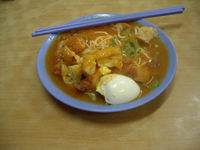
Mee rebus, typical Malaysian food
- Serai (lemon grass)
- Bawang merah (shallots
- Halia (ginger
- Lengkuas (galangal)
- Ketumbar (coriander
- Asam jawa (tamarind)
- Kunyit (turmeric)
- Saffron
- Jintan putih (cumin)
The traditional Malay way of eating is by using the right hand. The use of the left hand is considered bad manners. The same goes with receiving or giving things, always use the right hand.
In eating stalls or at homes where hands are used to eat, guests will provided with a pot of water to wash their hands before and after the meal. Remember, this water is not for drinking. Or you simply use the always available tap to wash your hands.
As with other cuisines, Malay food is prepared and enjoyed by all races. A staple breakfast favorite is nasi lemak. It is a simple but very satisfying meal. The rice is cooked in coconut milk with fragrant pandan leaves. Side dishes can be sambal ikan bilis (anchovies with chili), omelets or hard boiled eggs, peanuts, sliced cucumber, prawns and fried fish. If one Malaysia food can be named as the countries national dish, it's probably nasi lemak.
Another classic example of ever popular Malay food is satay. There's no pasar malam (night market) without satay. It usually consists of chunks of chicken marinated with a variety of spices.

Barbecued stingray
Rendang Tok is a meat dish (chicken or beef) prepared with coconut milk, chilies, onion, and other ingredients. Around Pangkor and Lumut the most famous kind of rendang is rendang tok. It contains beef, coconut milk, onion, garlic, chilies, coriander powder, cumin, black pepper, fennel, turmeric root, lemon grass and other ingredients. If you visit a Malay wedding, like I did some time back, you most likely will have some rendang as it is usually used for special occasions.
Laksa
Laksa is a good example of a crossover type of dish. The Malays probably make some of the very best laksa in Malaysia. Laksa is a kind of spicy noodle soup based on fish and spices. Here's a complete page about laksa. When I did my research I was surprised to find out how many different kinds of laksa there were.Back to the top
Indian food
Malaysian food from the Indian population is quite different from the Malay or Chinese cuisine. The Indians flavor hot and spicy flavors. Their staple diet usually consists of either rice or bread (chapatti, tosai (thosai, dosa in India), parrata, puri). They eat this with various curries. As in accordance with their Hindu beliefs, they do not eat beef.
Milk Tea, Teh Tarik
Usually Indian Malaysian food is sold at the various local stalls and often ordered with a glass of teh tarik. Teh Tarik literally means "pulled tea". The tea is thick and frothy. The preparation involves passing the tea and milk from one big metal mug to the other with a "pour and pull" action.
Where there is roti canai, there is bound to be murtabak. This is basically roti canai with stuffing of sardines or chicken as the Indian Hindus do not eat beef. Murtabak with beef however can be obtained from stalls owned by Muslims.

Typical Malaysian food: Roti Canai
One could say the apart of nasi lemak, roti canai is probably the second national Malaysian food.
Indian mee was first created by Indian sailors and port workers. It is a combination of Chinese fried noodles with prawn fritters, potato, squid, taukua (bean curd, bean sprouts and lettuce). For more filling, an egg is usually scrambled into the mix. Mention North Indian food and what comes to mind is tandoori chicken and naan bread. Both are cooked in clay oven called tandoori. Northern Indian food is found in air-conditioned restaurants, richly decorated to reflect the Indian culture and Hindu tradition.
Ingredients as yoghurt's and ghee are liberally compared to Southern Indian cuisine, which uses a lot of coconut milk and chilies. Even the staple diet is different, rice for the South, bread for the North. Nevertheless, both are equally spicy and delicious.
Back to the top
Chinese Food
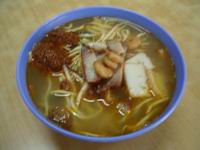
Shrimp noodles or hokkien mee
It's another of the local favorite Malaysian foods. The Hainanese also produced steamboat, sort of Oriental variation of the Swiss Fondue, where you have a boiling stockpot in the middle of the table into which you deep pieces of meat, seafood and vegetable.
The Hokkiens have provided us the Hokkien fried Mee (thick egg noodles cook with meat, seafood and vegetable and a rich soy sauce. Mind you, if you go to North Malaysia, Hokkien Mee means prawn soup noodles. Hokkien spring rolls (popiah) are also delicious.
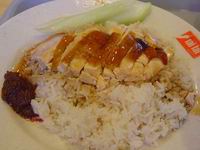
Chicken rice
Hakka dish is also easily found in food centers. The best know hakka dish is the Yong Tau Foo (stuffed seafood bean curd) with soup or thick dark gravy.
When people in the west speak of Chinese food, they probably mean Cantonese food. It is the best known and most popular variety of Chinese food. Cantonese food is noted for the variety and the freshness of it's ingredients. The food are usually stir-fried with just a touch of oil. The result is crisp and fresh. All those best known 'western Chinese' dishes fit into this category - sweet and sour dishes, won ton, chow mein, spring rolls.
With Cantonese food the more people you can muster for the meal the better, because dishes are traditionally shared so everyone will manage to sample the greatest variety. A corollary of this is that Cantonese food should be balance: traditionally, all foods are said to be either Yin (cooling) - like vegetables, most fruits and clear soup; or Yang (healthy) - like starchy foods and meat. A cooling food should be balance with a healthy food and too much of one it would not be good for you.
Dim Sum
Off all Malaysian foods the Cantonese specialty is Dim Sum or 'little heart'. Dim sum is usually consumed during lunch or as a Sunday brunch. Dim sum restaurant are usually large, noisy affair and the dim sum, little snacks that come in small bowls, are whisked around the tables on individual trolleys or carts. As they come by, you simply ask for a plate of this or a bowl of that. At the end the meal you are billed is the amount of empty containers on your table. Read more about Dim SumCantonese cuisine of the Malaysian foods can also offer real extremes. You can get shark's fin soup or bird's nest soup which are expensive delicacies. Cheap dishes include mee (noodles) and congee (rice porridge) and are equally tasty.
Far less familiar than the food from Canton are the cuisines from the north and the west of China - Sichuan, Shanghai and Peking. Sichuan food is usually spicy (gong bao for example is a chicken rice dish with cashew nuts and spices). Where as to food from Canton are delicate and understated, in Sichuan food the flavors are strong. Garlic and chilies play their part in dishes like diced chicken and hot and sour soup.

The huge bowl of the 3 in 1 soup, a mix of laksa, curry mee and ho kien mee
Other kinds of Chinese foods originated from for example Shanghai or Hunan (usually very spicy too) are not easily found over Malaysia.
Mooncake
A very special pastry can be found all over Malaysia during the Moonfestival periode, usually around early October. Here's more about the Moonfestival and Mooncakes.Restaurants
Although there are a few good Chinese restaurants at Pulau Pangkor (think of the Ye Lin, next to the Coral Bay Resort) or and the Sea View Hotel (try there the re excellent curry mee, some of the best Chinese food is to be found 9 km land inwards in Sitiawan. For some excellent vegetarian food, try Jie Shan Lou Vegetarian Restaurant on the main road in Sitiawan at Jalan Lumut.Tzien Fatt is to me the best noodle stall in Sitiawan. My favorite dish with Sunny and Doreen is their 3 in 1 soup, a mix of laksa, curry mee and ho kien mee (prawn mee or mee udang). Many locals do not believe this combination could possibly work but agree with me when they finish their bowl. And once you're there, try their special fruit juice. I never ask Sunny what he has, I let him make me a class and I am never disappointed! Fruit juice with ice, contrary to many other places where you get ice with some fruit juice. You get the point.
to be continue

No comments:
Post a Comment